



What is Active Learning?
The typical college student’s attention span ranges between 9 and 11 minutes (Prince, 2004). However, it’s not uncommon for classes at Auburn University to be made up of 50 minutes, to even 4+ hours, of lecture.We know content dissemination is important, but how can you ensure your students get all the information they need without losing their attention along the way? Active learning. Active learning is any approach to instruction in which all students are encouraged to engage in the learning process. This pedagogy is often referred to as Engaged Active Student Learning (EASL) at Auburn University.Students prepare for EASL classes by either completing assigned readings or watching digital content before class. During class, faculty spend some of their time engaging students in collaborative activities and discussions. It’s important to note that using active learning strategies does not mean that faculty abandon lecture all together. Rather, adding small active learning strategies to your class can make lecturing more effective for student learning. These activities give students a moment to check their understanding of recent material, practice a skill, or identify gaps in their knowledge.
A well-established bank of research that supports the use of active learning. The benefits of active learning are many, including:
- Increased content knowledge, critical thinking, problem-solving abilities, positive attitudes towards learning in comparison to traditional lecture-based delivery (Anderson et al, 2005),
- Increased enthusiasm for learning in both students and instructors (Thaman et al., 2013)
- Developing important skills employers are looking for when recruiting new college grads, such as critical and creative thinking, problem-solving, adaptability, communication, and interpersonal skills (Kember & Leung, 2005)
- Improved student perceptions and attitudes towards information literacy. (Deltor et al., 2012)
Even more telling of its benefits is Freeman et. al’s (2014) meta-analysis of 225 studies comparing active learning approaches with traditional lecturing which showed improved exam scores and decreased failure rates for active learning. In their analysis, students in courses without active learning were 1.5 times more likely to fail the course than students in courses with active learning. The authors write, “If the experiments analyzed here had been conducted as randomized controlled trials of medical interventions, they may have been stopped for benefit –meaning that enrolling patients in the control condition might be discontinued because the treatment being tested was clearly more beneficial.”
Implementing active learning strategies in the classroom comes with some unique challenges. Students may be resistant to engage with activities if they have never had to actively participate in a class and take responsibility for their own learning. Be transparent with students about the fact that you will be implementing active learning. Auburn University denotes most active learning classes held in the Mell Classroom Building @ RBD Library, Haley Center, Science Center Classroom, and Miller Hall with either EA1 or EA2 in AU Access when students register for classes. Faculty can use Course Toolkit to email registered students before classes start to provide information about the nature of your class. You may consider including information in your syllabus and Canvas course. Talking through expectations for an active learning class before the class, on the first day, or first week, allows students to decide if this is the right learning environment for them.It may be hard to imagine balancing content dissemination with active learning activities in 50 minutes. But take some time to consider your learning objectives carefully. In 5 years, what do you hope your students remember from your class? As Dr. Karl Smith of the University of Minnesota frames the question, “We can certainly lecture a long time and fast and cover a lot of information with our students. But at the end of a class period, how much information has been uncovered to them?” Your special value as a faculty member is not introducing content, any search engine can do that, rather it is to provide guidance and feedback as students attempt to master higher levels of learning. It may also be a challenge to give up your centralized role as “expert” to allow students to interact and learn from each other. However, discussing information in groups with differing perspectives, experiences, or knowledge creates opportunities for students to bring their experiences into the classroom and benefit from the experience of others. When discussing new information in class, be sure to conduct a large group debrief to wrap up the discussion and ensure all students are on the same page, this will also give you an opportunity to provide your expert knowledge on the topic.
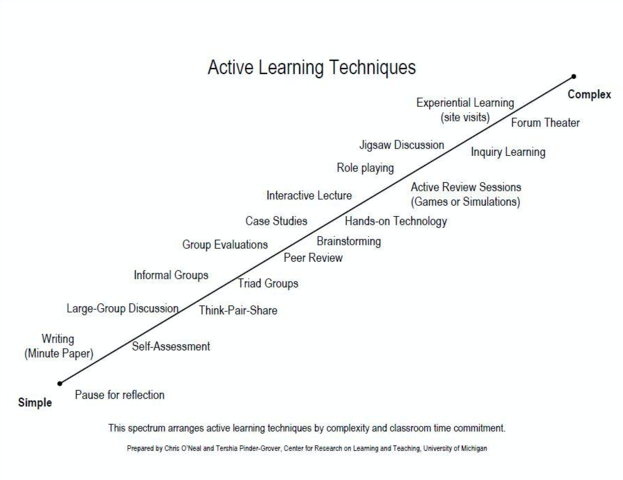
This spectrum arranges active learning techniques by complexity and classroom time commitment.
As with anything new, start small at first. You might find it helpful to develop a “signature string” of active learning activities to save you time when preparing each lesson plan. Consider incorporating one of the following four activities –one-minute paper, think-pair-share, debrief discussion, gallery walk. In a typical 50-minute class, each 10-minute increment would be punctuated by an activity. This formula accommodates the typical student’s 9 to 11-minute attention span and resets their focus every 10 minutes with an activity.The one-minute paper, think-pair-share, and gallery walk techniques provide a way to incorporate active learning approaches that offer students an opportunity to organize and clarify their thinking without sacrificing content. Remember, as you begin to incorporate active learning activities into your classes, be sure to explain to your students why you’re doing so. Talking to your students about their learning helps build a supportive classroom environment and develops their metacognitive skills.
