



Getting Started
As an instructor, there are three elements within your control in the classroom: One is the design of the course, the second is the facilitation of the course, and the third is reflecting on the success of the course. Of the three, course design is perhaps the most overlooked, because most of us begin teaching by modeling our courses on the materials of others. However, in doing so, we miss the opportunity to create significant learning experiences based on the special value and expertise we bring to the course.
Backward design is the process of identifying student learning outcomes to make decisions about what happens in a course and when, as opposed to using chapters in a textbook to develop a course schedule. In the backward design process, you begin by identifying situational factors that impact your decisions, choosing course goals that lead to significant learning (as opposed to merely content learning), designing assessments to provide evidence that students have achieved the course goals, and finally, by planning learning activities to help students achieve the course outcomes.
Backward design allows you to ensure that students in your course will not simply learn content but also to consider how that content impacts their beliefs and attitudes about a subject, as well as how they might apply learning in real-word contexts. Your job as a faculty begins with setting high expectations that learning will not be merely assessed by a score on a test, but rather, by how deeply students connect content to big picture learning and professional goals. You will communicate these expectations both through the syllabus and through the quality of the design itself, i.e. through the careful integration of learning goals, activities, and assessments throughout the duration of the course.
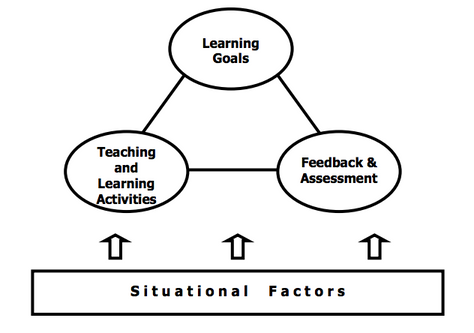
The first step in backward design is a careful consideration of your situational factors. Situational factors include things such as: number and level of students, furniture and technology of your classroom, time of day, day of week, and an awareness of your own strengths and preferences that you bring to the learning environment.
Dee Fink’s A Self-Directed Guide to Designing Courses for Significant Learning provides guiding questions across five areas to identify situational factors that might influence your course.
The image illustrates the importance of situational factors to the three components of backward design. It is the context that will inform all decisions you make about the learning goals, how to measure them, and how to achieve them
3 Stages to Backward Design
In stage one, define your learning outcomes by envisioning what is important for learners to understand. Take a moment to imagine you are leading a class with perfect students. They read everything, they come prepared with questions, and you realize these students can learn anything. What will they learn from you?
In articulating your significant learning goals, you may wish to refer to Bloom’s Taxonomy, a framework for categorizing levels of learning. What level is most appropriate for your goal and for your students?
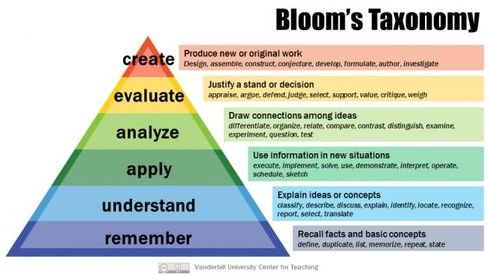
These “action words” will help you articulate learning outcomes that are pitched at varying levels of learning.
- Remember
- Recognize
- Recall
- Understand
- Classify
- Summarize
- Compare
- Explain
- Apply
- Execute
- Solve
- Analyze
- Differentiate
- Organize
- Compare / Contrast
- Evaluate
- Weigh
- Critique
- Create
- Generate
- Plan
- Produce
In stage two, you are identifying the evidence you and your students need in order to assess progress toward your learning outcomes. Most of us are familiar with a content-centered course in which feedback and assessment include two mid-terms and one final exam and that’s it. However, in a learner-centered course, a more sophisticated approach to feedback and assessment is necessary.
Educative assessment combines forward-looking assessment and a self-assessment by the learners. In the forward-looking assessment, faculty will “look forward”, beyond the time span of the course, and formulate a question or problem for students to consider. Also known as problem-based learning, this assessment might take the form of a semester-long project, case studies, or multiple-choice questions that challenge students to look beyond the content. In this assessment, be sure to clearly explain the criteria and standards that will be used to evaluate your students work. A rubric that lists general traits or characteristics of high-quality work or examples of successful past projects will be helpful.
Professionals are constantly asked to assess their own work, so students should be given the opportunity to practice the skills of self-assessment. In this type of assessment, you might consider asking the students to create their own rubrics. Other examples of assignments that include self-assessment are: exam wrappers, ePortfolios, or reflections assigned at strategic points during the semester. Although they will practice assessing themselves, faculty should still provide high-quality feedback using the “FIDeLity” feedback framework.
- Frequent: Give feedback daily, weekly, or as frequently as possible.
- Immediate: Get the feedback to students as soon as possible.
- Discriminating: Make clear the difference between poor, acceptable, and exceptional work.
- Loving: Or respectful feedback means being empathetic in the way you deliver your feedback.
In stage three, you design learning activities that challenge students to achieve the goals you set for them. Although most of us simply think of activities as the things you have students do in or out of class, a more helpful way to think of them is in the following three-part structure:
- introduction to ideas and information
- experiences that challenge students to apply new information or ideas
- opportunities to reflect on those experiences in order to convert short term memories to long term learning.
Most of us are comfortable designing lectures, a learning activity that introduces ideas, but we know from research that active learning approaches lead to better student outcomes. Active, or student-centered, learning is an approach to instruction in which all students are asked to engage in the learning process. Active learning activities can take the form of full class debates or simple moments of reflection interspersed into your lecture to give students a chance to check their understanding of recent material, ask a question, or identify gaps in their knowledge.
An effective set of learning activities gives students appropriate time to engage with all three components of rich learning: exposure to information and ideas, experiences, and reflective dialogue. However, time constraints mean that you will need to decide which parts of the learning process should take place in the classroom and which can be assigned as homework. In other words, you need to decide the “what” as well as the “when” as you design the activities of your course.
Information and ideas expose students to the course content. What: Other than lectures, what ways can you identify for students to get their initial exposure to subject matter and ideas? When: Does it make more sense for students to do this work outside of class?
Experiences include the students doing, observing, or simulating using the course content. What: What are some rich learning experiences that will allow students to “do” or “observe” content appropriate to your course? When: Will you need to be there to provide feedback to students as they are more likely to make mistakes when they are “applying” new information than when they are simply trying to “understand” or “remember” new information?
Reflective dialogue is another important element to active learning that give students time and encouragement to reflect on the meaning of their learning experience. What: What kinds of reflective dialogue can you incorporate into your learning activities for your course? When: Can these reflections be completed quickly at the end of a class period or should they be assigned outside of class to be submitted via Canvas?
Backward design is not a philosophy or teaching approach. It is not about covering content, getting through a textbook, or doing fun activities. It is a rich and effective planning framework, one that makes you more goal oriented and helps you create a plan based on those goals.
